
Decayed, broken, and missing teeth affect your oral health and your self-confidence. When a tooth has suffered structural or cosmetic damage, a dental crown can restore a tooth’s function and appearance.
A crown is a custom-made “cap” that covers the entire visible surface of a tooth. Your dentist might recommend a crown to:
- Strengthen and protect a tooth if extensive decay hasn’t left enough healthy tooth structure for a traditional filling
- Protect a cracked, broken, or brittle tooth from further damage
- Restore and reinforce a tooth after a root canal procedure
- Cover a deeply discolored or irregularly shaped tooth
- Complete a dental implant procedure
- Serve as an anchor for a dental bridge
Most crown placements require two appointments. During the first visit, tooth preparation includes reshaping the top and sides of the tooth so the crown fits comfortably. If too much healthy tooth structure has been lost, the dentist builds up the tooth with filling material so that it will support a crown securely.
An impression or a computer model is made of the prepared tooth, and a temporary crown, typically made of composite resin, is put in place to protect the tooth while the finished crown is fabricated at a dental lab. Every crown is custom-designed to make sure it fits comfortably, aligns with the surrounding teeth, and doesn’t interfere with bite or jaw movement.
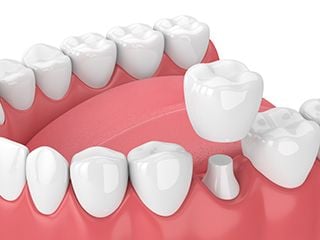 At a second visit, the dentist puts the finished crown in place and makes any needed adjustments to ensure that it fits properly before bonding it to the tooth. When the placement is ideal, the crown is secured in place using a special dental cement.
Crowns are made of several different materials. Your choice of crown can be based on factors such as durability, visibility, natural appearance, and cost:
- Metal crowns: Because they are alloys of gold, platinum, or other metals, these crowns are the longest-lasting. They’re often chosen for back molars, where they are less visible.
- All-porcelain/All-ceramic: These color-matched, translucent crowns are the most realistic-looking option, especially for front teeth. They are also suitable for those with metal allergies.
- Porcelain fused to metal: These crowns have a porcelain layer applied over a metal core. Matched to your natural enamel color, these crowns look very realistic, although they’re not as translucent as all-porcelain crowns.
- Stainless steel: Typically used for baby teeth, pre-formed stainless steel crowns are a durable, cost-effective option when a crown is needed for a primary tooth.
- Composite resin: Made of color-matched resin, these crowns are a more affordable choice than porcelain or metal. Generally, however, they are only used as temporary crowns since they’re much less durable than other options.
Because a crown improves both the form and the function of a tooth, it is one of the most popular restorative treatments available. Talk to your dentist to discover how a crown can enhance the health and appearance of your smile.